

The Dad’s Launch Protocol: Why Starting Small Is the Only Strategy That Works
You’ve tried the 5 AM workouts and elaborate meal prep. Every time, you’re back to square one within a month. Here’s the counterintuitive approach that actually sticks.

Bottom Line Up Front
The 2-minute version of your habit beats the skipped 45-minute version—every single time
You’re not building muscle yet; you’re building the showing-up muscle. Consistency first, intensity later
Your environment is either helping or hurting. Move your phone, place your gym clothes visibly, redesign your defaults
Stack habits onto things you already do: “After I brush my teeth, I’ll do one pushup”
Stop measuring performance. The only metric that matters right now: did you show up? Yes or no
Before We Get Started
If you are a Rebuilder (paid subscriber), make sure to check out the Start on Sunday series to unlock my paint-by-numbers simple system for taking your results as a Rebuilder to the next level (and never coming back).
The Embarrassingly Small Habit That Actually Works
It’s Monday morning. You set your alarm for 5:30 AM because you finally committed to getting back in shape (again). You’ve got the workout planned. You’ve got the motivation. You even laid out your gym clothes the night before.
Then the baby was up at 2 AM. Your four-year-old crawled into bed at 4. And when that alarm hits, you’re running on three and a half hours of broken sleep.
So you do what any reasonable person would do. You hit snooze. You tell yourself you’ll work out tomorrow when you’re more rested. Tomorrow becomes Wednesday. Wednesday becomes “next week.” And three months later, those gym clothes are still folded on the chair, untouched.
Here’s what nobody tells you about building habits as a dad: the 45-minute workout you keep planning is the very thing killing your consistency. You’re not failing because you lack discipline. You’re failing because you’ve set yourself up to fail.
The Ambition Trap
You’ve been taught that ambitious goals require ambitious actions. That transformation requires intensity. That if you’re not going hard, you’re not going anywhere. I get that. I’m ambitious. It is how I’m wired so doing less is difficult.
But here’s what 25 years of coaching has shown me: ambition is the enemy of consistency.
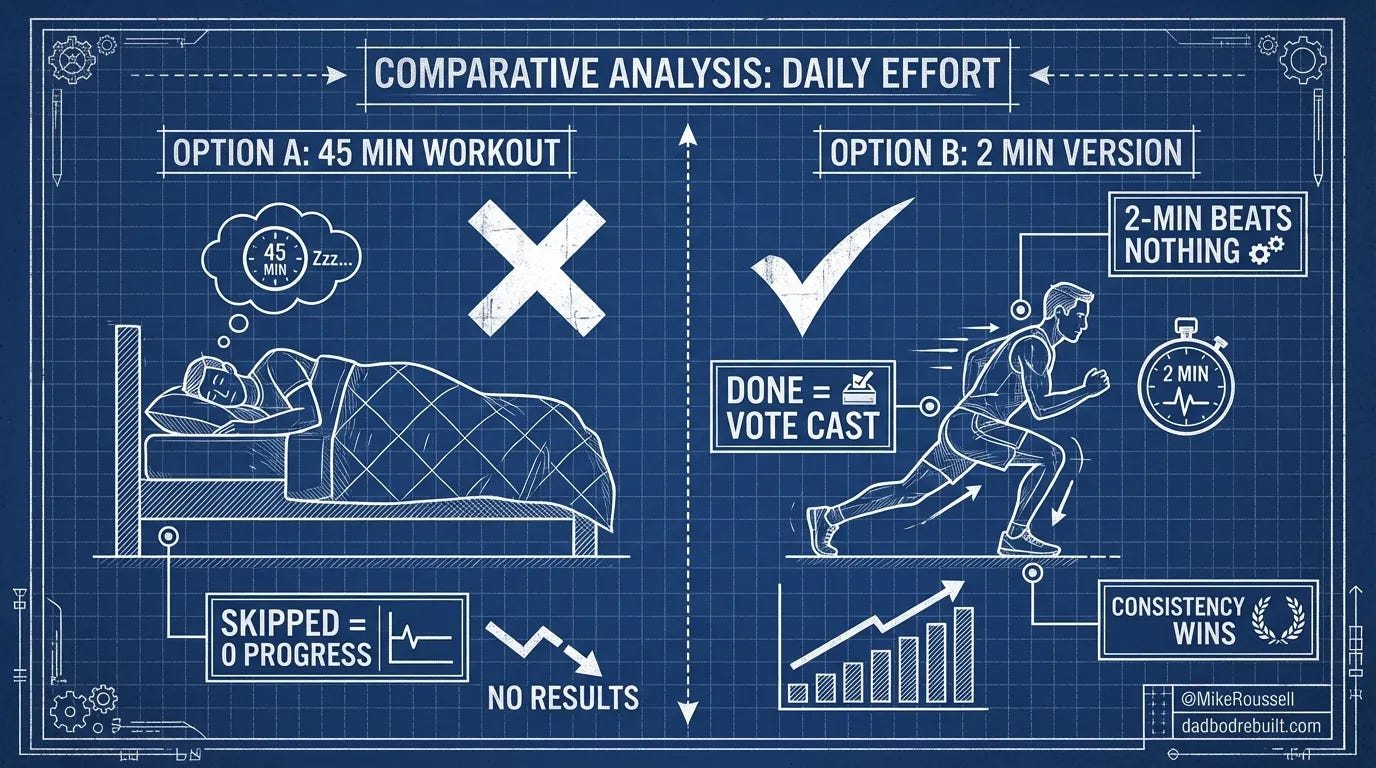
The dad who commits to a 45-minute workout will skip it when life gets chaotic. And life always gets chaotic. The dad who commits to two minutes of movement? He does it whether the baby slept or not. Whether work exploded or not. Whether he feels like it or not.
The 2-minute version beats the skipped 45-minute version. Every single time. You might be thinking that 2-minutes of exercise does nothing. True - but we’re rebuilding. We’re laying the framework and foundation for unstoppable future success. Sometimes you need to move a little bit slower so that you can go faster in the future for longer.
I’ve watched this play out hundreds of times. The dad who commits to “just getting on the floor” ends up doing pushups five days a week. The dad who commits to “a real workout” ends up doing one every couple of weeks—if that.
The math isn’t complicated. Five days of something small beats one day of something big. And those five small days compound. They build momentum. They create identity. The one big day? It creates soreness and a vague intention to “do it again soon.”
What You’re Actually Building
Here’s the part most guys miss. In the early weeks, you’re not building muscle. You’re not building endurance. You’re building something far more important: the habit of showing up.
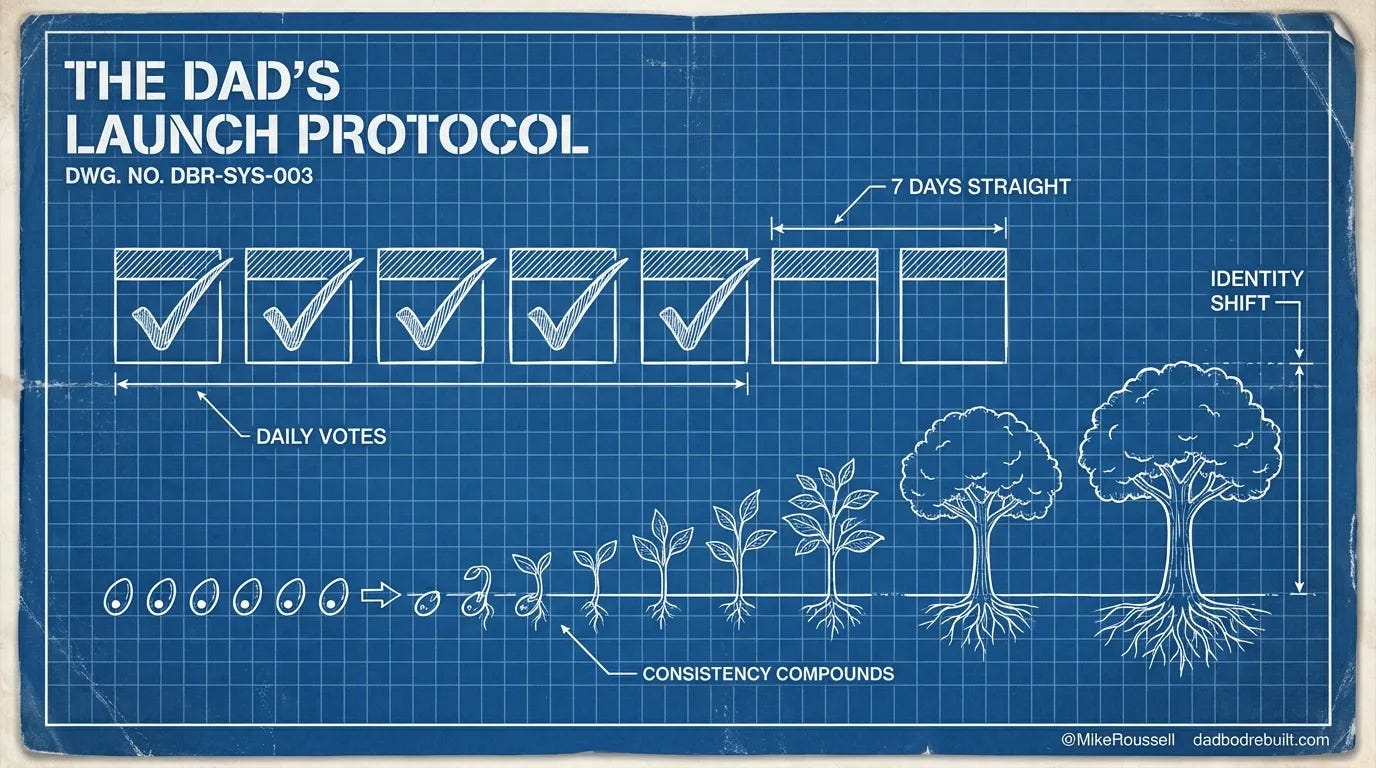
Every time you show up—even for two minutes—you’re casting a vote for the kind of dad you want to be. You’re proving to yourself that you’re someone who prioritizes your health. Someone who follows through. Someone who doesn’t quit when it gets hard.
Those votes compound. Over time, they become your identity.
But when you skip because the workout was too ambitious? You’re casting votes in the opposite direction. You’re reinforcing the story that you’re someone who can’t stick with things. Someone who starts strong and fades.
This isn’t about fitness yet. It’s about identity. You’re shifting from “I’m trying to get in shape” to “I’m the kind of dad who shows up.”
The 2-Minute Rule
Here’s how to apply this: take whatever habit you want to build and shrink it down until it takes two minutes or less.
Want to work out? Commit to one pushup. Want to meditate? Commit to four rounds of tactical breathing. Want to read more? Commit to one page. Want to eat better? Commit to protein at breakfast.
This feels ridiculous. That’s the point. A habit so small that “I don’t feel like it” isn’t a valid excuse. You don’t need motivation to do one pushup. You just need to get on the floor.
The key is attaching this tiny habit to something you already do every day. “After I brush my teeth, I’ll do one pushup.” “After I pour my coffee, I’ll review my three priorities.” “After I sit down at my desk, I’ll drink a glass of water.”
This is the premise of the Tiny Habit Method developed by Stanford psychologist BJ Fogg. I call it habit stacking, and it works because you’re hijacking neural pathways that already exist. You don’t have to remember to do the new thing—the existing habit reminds you.
Your Environment Is Either Helping or Hurting
Now here’s the second piece most dads miss: willpower has an expiration date.
Every decision you make throughout the day chips away at your willpower tank. By evening, after navigating meetings and deadlines and kid chaos, you’re running on fumes. This is why you can resist the chips at lunch but demolish a sleeve of Oreos at 9 PM. It’s not a character flaw. It’s resource depletion.
The dads who maintain habits long-term aren’t more disciplined than you. They’ve likely stopped relying on discipline. They’ve engineered their environment so the right choice is the easy choice.
Make the right choice, the easy choice.
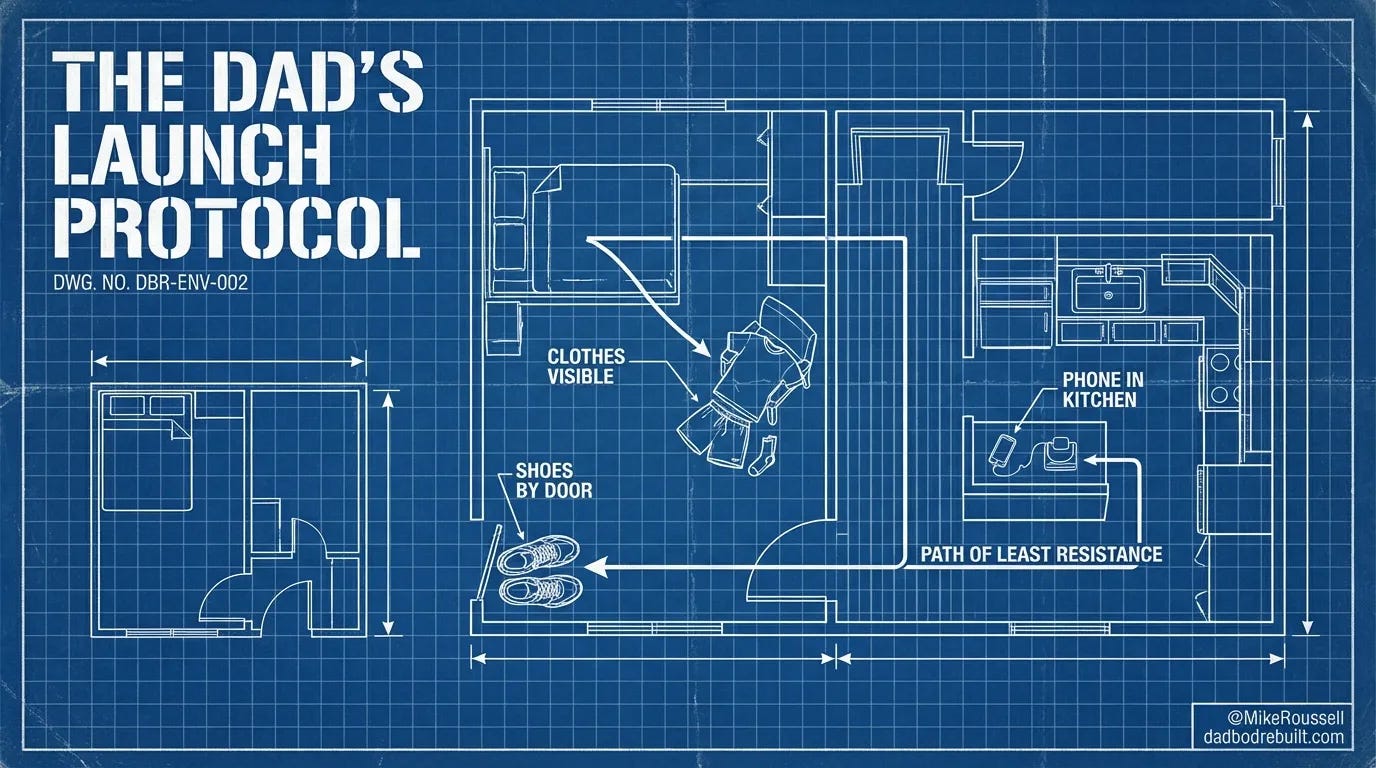
Think about two dads with the same goal of morning runs. Dad A keeps his running shoes in the back of the closet. His phone charges on his nightstand. When his alarm goes off, he reaches for the phone, scrolls “just for a minute,” and twenty minutes later he’s still in bed. No time for the run.
Dad B put his running shoes by the bedroom door. His phone charges in the kitchen. When his alarm goes off, there’s nothing to grab. His shoes are literally in his path. He’s dressed and out before his brain has time to negotiate.
Same goal. Same motivation. Same busy life. Different environment. Different outcome.
Your environment is either green lights or red lights. It’s either pulling you toward your goals or pushing you away. There’s no neutral. The placement of your phone, the location of your gym clothes, what’s visible when you open the fridge—all of it is either helping or hurting.
Three Environment Changes That Work
Here’s what to do about it:
Add a visible cue. Put your workout clothes on top of your dresser, not in a drawer. Put a water bottle on your desk. Put a book on the coffee table instead of the remote. Make the thing you want to do impossible to miss.
Remove an obstacle. If your gym clothes are in the closet, you have to make a decision to get them. If they’re already out, there’s no decision. If healthy food requires preparation, you won’t eat it at 9 PM. If it’s grab-and-go, you will.
Redesign a default. Your phone on the nightstand defaults you to scrolling. Your phone in the kitchen defaults you to getting up. Chips in the pantry default you to eating chips. An empty shelf defaults you to something else. Change what happens when you don’t make an active choice.
The goal is to make the path of least resistance the healthy path. Especially at 6 AM. Especially when you’re exhausted. Especially when every part of you wants to take the easy route.
Build the Chain
Once your 2-minute habit is running and your environment is supporting you, the next step is linking behaviors into a chain.
Map out your morning—not the ideal version, the honest version. What time do you actually wake up? What do you actually do first? Where are the dead spots, the transitions, the moments you’re currently wasting on autopilot scrolling?
Those dead spots are insertion points. “After I brush my teeth” is an insertion point. “After I pour my coffee” is another. “While the coffee brews” is time you’re already spending—you can hijack it.
Build a chain: After I brush my teeth, I do 10 pushups. After pushups, I get dressed. After I pour coffee, I review my three priorities. After priorities, I drink my protein shake while the coffee cools.
The power of a chain is that it reduces multiple decisions to one. You don’t decide to do pushups, then decide to get dressed, then decide to review priorities. You decide to start the chain. Everything else flows automatically.
The Real Metric
Here’s how you know this is working: don’t measure performance, measure presence.
If you planned a 30-minute workout and only had time for 10 minutes, you succeeded. If you did the bare minimum 2-minute version because life was chaos, you succeeded. If you showed up for 7 days straight—regardless of intensity—you succeeded.
The only way to fail is to not show up at all.
Performance improvements come later, after the habit is locked in. Right now, you’re training your brain to expect this behavior daily. You’re building neural pathways. You’re casting votes for identity.
Stop grading yourself on how hard you went. Start grading yourself on whether you showed up.
What This Looks Like in Practice
James is 42, a marketing director with two kids under 10. For three years, he kept failing at fitness. Gym memberships abandoned. Home workout programs unwatched. Early morning attempts destroyed by sleep deprivation. He enlisted me to help with his nutrition but he asked about help with his fitness as well.
So we took his goal and made it simplier, then simplier, then simplier. So simple, he couldn’t lose.
One pushup after brushing his teeth. That’s it. One pushup.
Day one felt pointless. Day two felt silly. Day three, he did five without thinking about it. By the end of week one, he’d shown up every single day—something he’d never done with any other approach.
By week four, his “one pushup” had organically grown to 15-20. He’d added a morning planning ritual while his coffee brewed. He was eating protein at breakfast because he’d made it the default option in his fridge.
Eight weeks in, James wasn’t “trying to get healthy” anymore. He was someone who works out. Someone who has a morning routine. The identity shift happened because he stopped chasing ambitious workouts and started collecting tiny daily votes for the person he wanted to become.
That’s the protocol. Start embarrassingly small. Engineer your environment. Stack habits into chains. Show up every day, even imperfectly. Let consistency build identity.
The transformation you want will follow. But first, you have to become someone who shows up.
One pushup at a time.