

The Weekend Advantage
The Monday motivation problem isn’t discipline. It’s a cognitive debt you signed up for Saturday night — and the data proves it.

BLUF (Bottom Line Up Front):
Weekends are 28.5% of your year. Lose them and you’re running at 71% capacity before you even start
The “Monday motivation problem” is often Saturday cognitive debt. Peer-reviewed meta-analysis shows measurable next-day impairments in attention, memory, and psychomotor speed — and tasks require more mental effort to complete
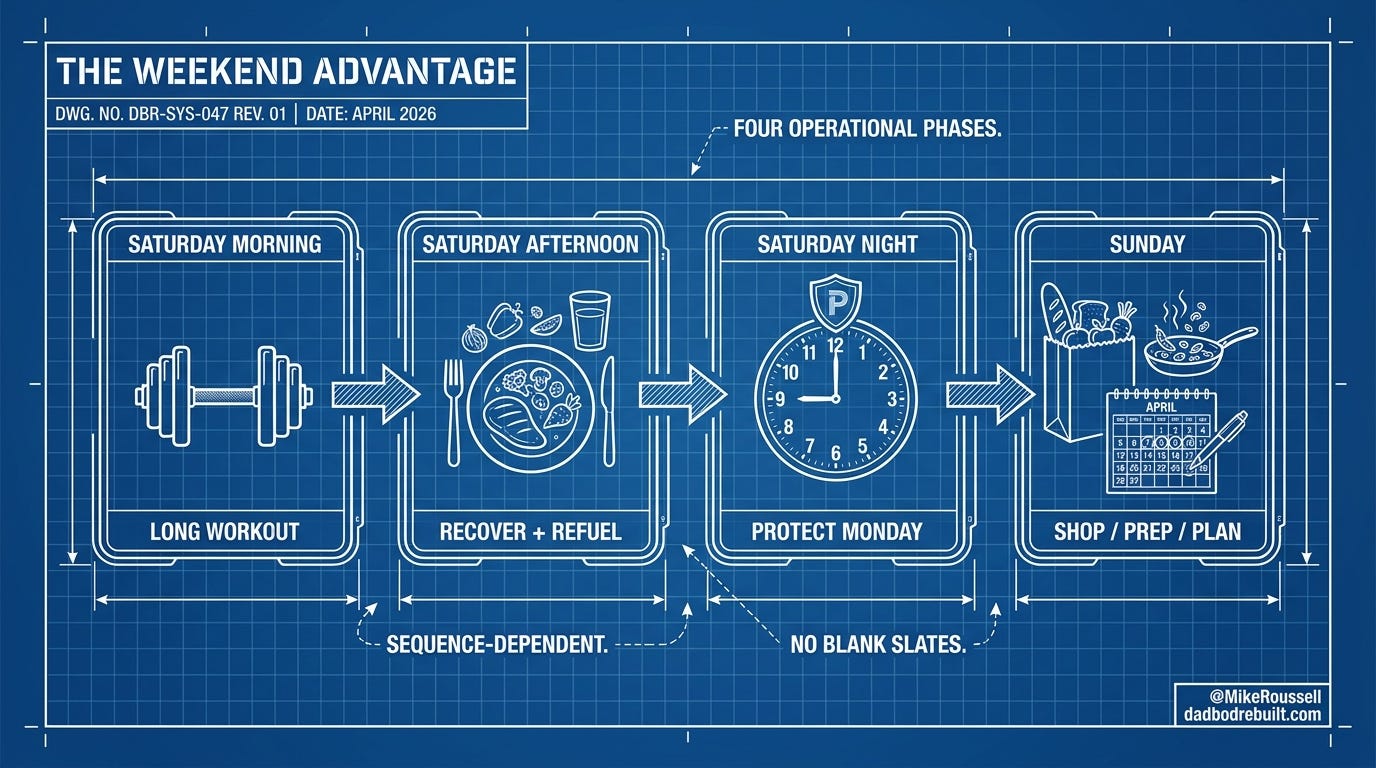
Rebuilders use weekends as the accelerator: longer Saturday training, Sunday grocery-prep-plan block, 30 minutes of strategic audit before Monday hits
Four pre-built weekend IF-THENs below. Next week: the full Weekend Contingency Vault
Your Monday Motivation Problem Isn’t Discipline — It’s Saturday
Here’s a thought experiment that will make you uncomfortable.
If you ate whatever you wanted on Tuesday and Wednesday every single week — skipped your workouts, stayed up too late, had a few beers, ordered takeout — would you be confused about why you weren’t hitting your goals?
Probably not. You’d know exactly what needed to change.
And yet, somehow, we mentally fence off Friday night through Sunday as a consequence-free zone. Same destructive behavior. Different days of the week. We convince ourselves it doesn’t count.
It counts.
The Math Nobody Wants to Do
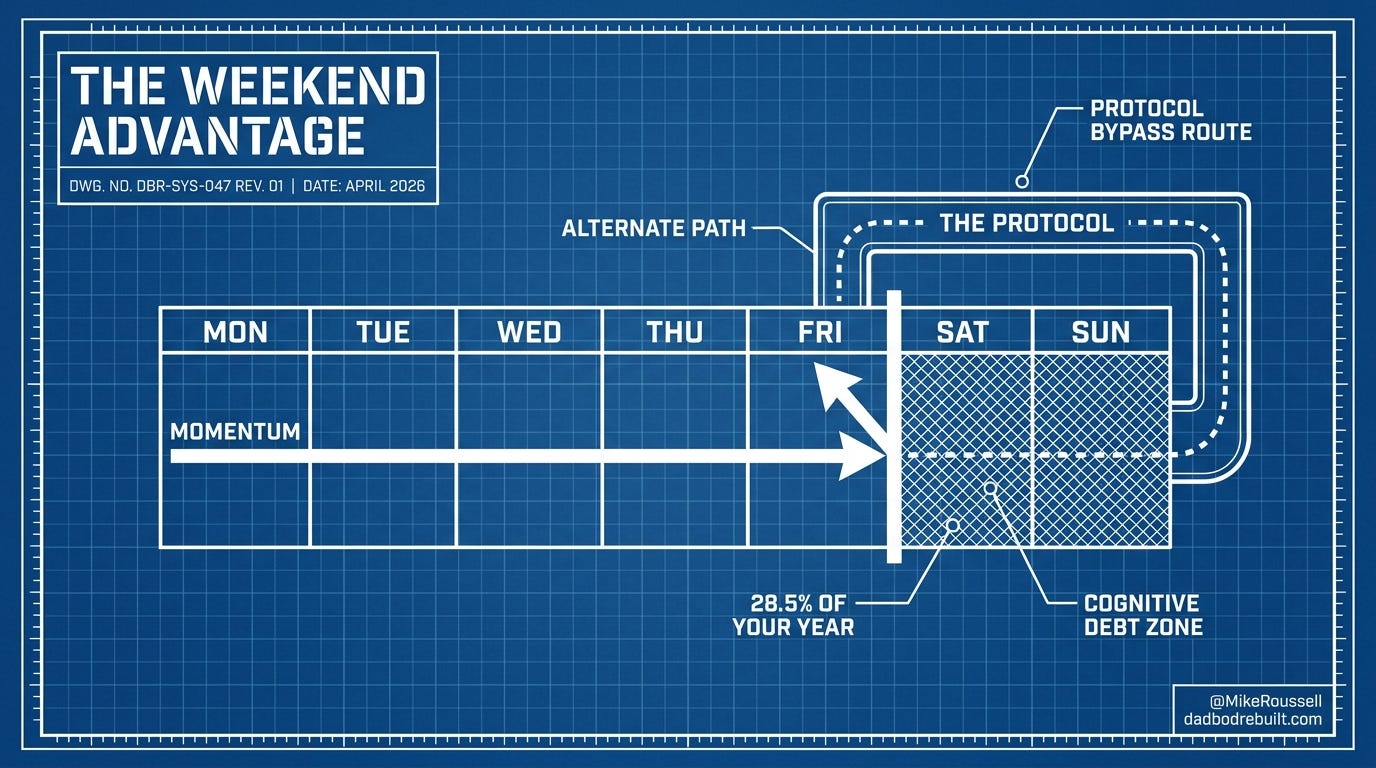
There are 52 weekends per year. That’s 104 days — 28.5% of your entire year. If you’re “off” every weekend, nearly one-third of your annual effort just disappears.
A guy who’s disciplined Monday through Friday but treats weekends as a free-for-all is running at 71% capacity. At best. And that’s assuming perfect weekday execution, which isn’t happening either.
This is exactly how the Restart Loop perpetuates itself. You’re not starting over every Monday because you lack discipline. You’re starting over because you’re unknowingly sabotaging yourself Friday through Sunday, then wondering why momentum never builds.
I had a client named Rob — an accountant with three kids — who swore he was eating at a deficit. Couldn’t understand why the scale wasn’t moving. I asked him to track everything for two weeks. Monday through Thursday, he was clean: slight deficit, hitting his 30/10, training three times. Friday was roughly maintenance. Saturday? A kid’s birthday party at 2 PM — three slices of pizza, two beers, cake. Dinner out with his wife — a burger, fries, two more beers. He ate 1,847 calories over his Monday-Friday average on Saturday alone. Sunday wasn’t much better.
Net result for the week? He was gaining, not losing. And he had no idea until he saw the numbers.
Why Monday Feels So Much Harder Than It Should
Here’s what most guys miss about weekends — and it’s the piece the fitness industry almost never talks about.
You don’t just lose ground on what you eat and drink Saturday night. You lose ground on how well you can execute the following Monday and Tuesday. And there’s real research behind this.
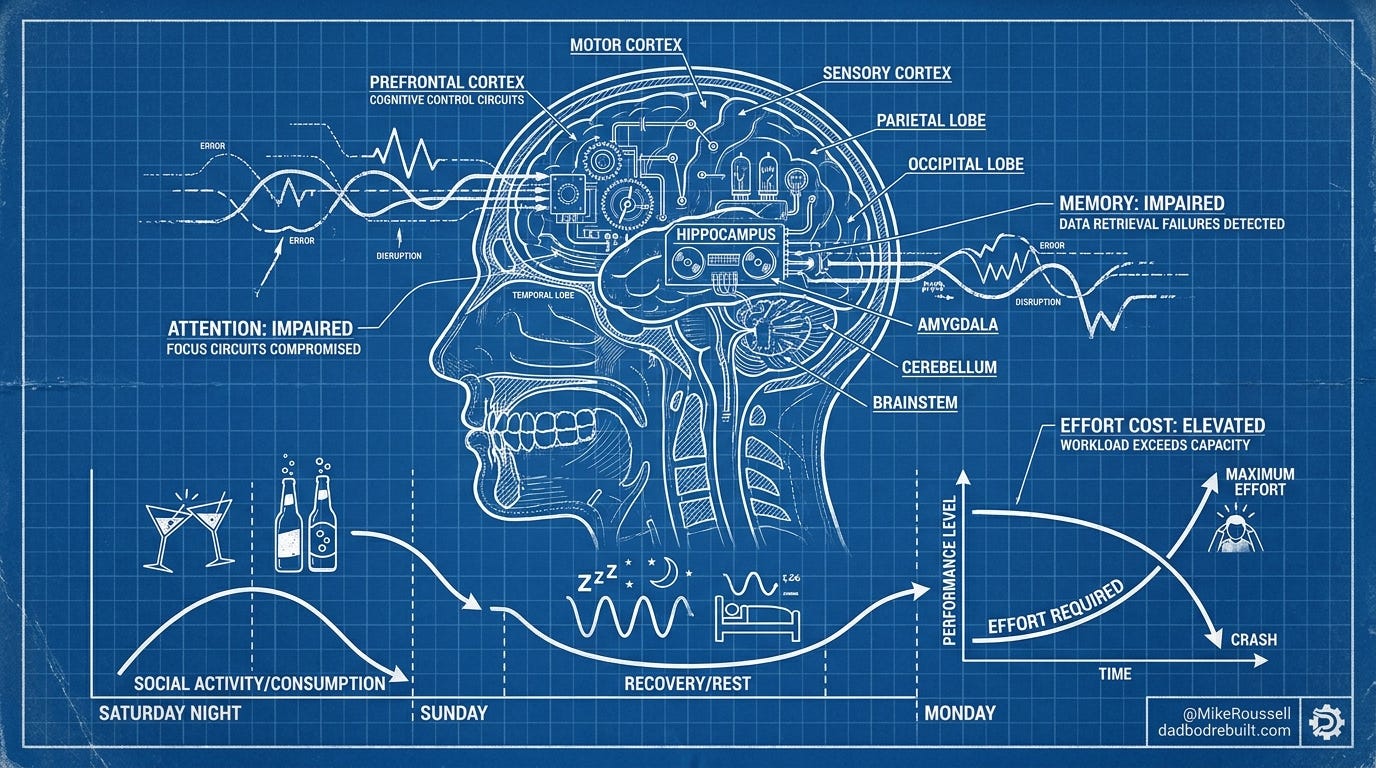
A 2018 systematic review and meta-analysis published in Addiction pooled data from 19 studies and over 1,100 participants to answer a simple question: what happens cognitively the day after heavy drinking, once the alcohol is fully metabolized? The answer wasn’t subtle. Short-term memory, long-term memory, sustained attention, and psychomotor speed were all measurably impaired. Not wrecked. Not catastrophic. But measurably worse — with medium effect sizes that translate to real-world consequences.
